People think the press gets a lot wrong. Maybe they’re right.

Americans trust the news media less than ever: “Just 29% of Americans say that news organizations generally get the facts straight, while 63% say that news stories are often inaccurate,” according to the latest results from the Pew Research Center released this week. That represents a drop of 10 percentage points from 2007, when 53% of Americans said that news stories were often inaccurate. And an alarming 70 percent of people surveyed believe that news organizations “try to cover up their mistakes.”
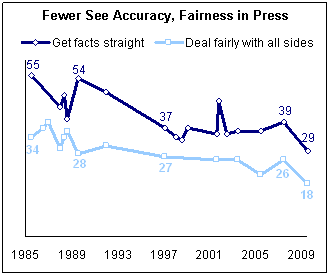
Pew Research Center survey report There’s a problem here, for sure. Many journalists understand this and work hard, every day, to try to solve it. Others are in denial. In reaction to this report, journalism scholar Jay Rosen wrote the following series of tweets yesterday:

Top explanations from journalists for fall in public confidence: 1. All institutions less trusted; 2. Cable shout-fest; 3. Attacks take toll

Top explanations from journalists for fall in public confidence, cont. 4. Environment more partisan; 5. Public confusion: news vs. opinion.

Top explanations from journalists for fall in public confidence, cont. 6. People want an echo chamber; 7. Numbers don’t really show a fall.

Each of these explanations doubtless has some merit. But together they constitute a kind of head-in-the-sand stance. Missing from the list is the simplest, most obvious explanation of all: Maybe we’ve lost confidence in the press because of its record of making mistakes and failing to correct most of them.

In other words, perhaps so many people think the news is full of inaccuracies because, er, they’re right.

Read Craig Silverman’s excellent book Regret the Error, based on his blog of the same name, and you’ll learn the sad numbers from the best studies we have on this topic: They show that the percentage of stories that contain errors ranges from 41 to 60 percent. Scott Maier, a journalism professor at the University of Oregon who has studied this field, tells Silverman that he found errors are “far more persistent than journalists would think and very close to what the public insists, which I had doubted.” Only a “minuscule” number of these errors are ever corrected.

Some of these errors are substantive, others seemingly trivial. But each one of them leaves readers or sources who know the topic shaking their heads, wondering how much else of the publication’s work to trust.

Since reversing this dynamic is the central goal of MediaBugs, we’ll be writing about it a lot here.

Report an Error Report an error

Why do we bother to correct errors?

In a recent Washington Post column, the eminent editor and essayist Michael Kinsley argued that newspapers overdo it when it comes to correcting small errors. Kinsley mocks the New York Times for its attention to correcting such trivia as the name of a company called Voxox (it had been printed as “Vovox”) or that of the College of William & Mary (misprinted as William and Mary College):

Although the purpose of [the daily Corrections column] is to demonstrate the Times’s rectitude about taking facts seriously, the facts it corrects are generally so bizarre or trivial and its tone so schoolmarmish that the effect is to make the whole pursuit of factual accuracy seem ridiculous.

“Bizarre or trivial”? Really? I think these goofs look rather different to the folks at Voxox or the College of William & Mary. And the importance of correcting them lies not in some earth-shattering import to the facts themselves but rather in the bond of trust that is established when a publication is seen to care enough to correct them — and, inversely, the loss of trust that occurs when the publication doesn’t bother.

Remember that, for Joe at Voxox or Sue at William & Mary, the misspelled name isn’t just a tiny fact in a sea of information; it represents that person’s point of maximum contact with the publication. Each time these people think of that newspaper or magazine they’re going to remember, These are the folks who couldn’t even get my name right. Multiply that by all the careless errors that get made in the course of normal journalism and you can get some insight into why public trust in the media has been on a downhill curve for so many years.

On the Web, of course, when these errors happen, we get to talk back, and share our discontent, and begin to see that it is not uncommon.

Kinsley maintains that most gripes with the news are driven by partisanship:

The fad for elaborate and abject corrections, and factual accuracy in general, is based on the misperception that when people complain about the media getting it all wrong, what bothers them is that the newspaper identified the mountain inside Denali National Park as Mount Denali (as it is “referred to by many,” the Times defensively put it the other day) and not by its official name of Mount McKinley, which “has not been officially changed.” Nor do they care whether a reporter “misstated the size of the National Hockey League when Ed Johnston — a retired goaltender who is a proponent of safer headgear — helped the Boston Bruins win Stanley Cup titles in 1970 and 1972.” What bothers people is the refusal of the Times and other papers to call President Obama a socialist or a Muslim, or to say outright that talk radio hosts are vermin. In short, most complainers tend to be ideologues whose vision of an accurate newspaper is far different from that of the professionals.

Certainly, the Web teems with angry people on both left and right who are unhappy with the media. Satisfying any of them is an uphill and perhaps futile effort. But there’s a much wider population that has lost faith in the media for the simpler reason that, in their experience, reporters simply get too much wrong. It is for those people that the managing editors of the world devote a portion of their time and energy to fixing the spellings of names and other minor goofs — and coming clean about those fixes.

If your newsroom doesn’t make a commitment to fixing such errors publicly, then people will stop bothering to report them to you. They’ll assume you don’t care, and they’ll be correct. This downward spiral has already begun in many communities.

Our hope in starting MediaBugs is to begin the painstaking work of reversing this dynamic. We don’t think that it will be fast or easy. It’s a lot more difficult to win trust than to lose it. But it’s worth the effort!

Report an Error Report an error

Welcome to MediaBugs — getting started

Welcome to the MediaBugs blog! This is where we’ll be offering updates on the MediaBugs project, a winner of the 2009 round of the Knight News Challenge.

MediaBugs will be a place on the Web where people can bring errors and problems they’ve found in media coverage in their community, and try to get them fixed. We aim to provide a neutral ground where journalists and the public can work together to improve news coverage. Our pilot project is in the San Francisco Bay Area. We’re starting work on it now and expect to have a test version of the site up this coming winter.

You can read our Frequently Asked Questions page here.

Report an Error Report an error