New report! New video! New widget partner!

Today we offer a cornucopia of newness for you:

  • Hard to Get a Fix is the first of what we plan as a regular series of reports on the error reporting and correction practices of Bay Area media organizations. You can read its findings here, and also read our recommendations for best practices in error reporting and corrections.
  • Today we also unveil “The Story of MediaBugs: As Told By Men in Shorts,” a new light video (now showing at the top of our home page) that our friends at Beep Show made for us, explaining what we do, how it all works, and what to do when the TSA mistakes you for a notorious flamingo smuggler.
  • You can now see the MediaBugs widget in action on every article published at Spot.Us, the pioneering community-funded journalism site. The widget lets you report errors and problems right from an article page, instead of having to visit our site directly. We think it’s the best way for news organizations and readers to use MediaBugs, and we’re working on getting it adopted more widely.

Journal’s Sarb-Ox goof, Kos’s flawed polls: New kinds of errors demand new kinds of corrections

Once upon a time in journalism, an error was a mistake in a story, and a correction was a notice published after the fact fixing the error. This kind of errror and correction still exists, but in the new world of news the error/correction cycle keeps mutating into interesting new forms.

Consider these two recent examples, one involving the Wall Street Journal and Twitter, the other involving Daily Kos and its polling program.

On Monday morning, decisions were pouring out of the U.S. Supreme Court and keeping reporters who deal with it very much on their toes. I noticed a flurry of comments on Twitter suggesting that the court had struck down Sarbanes-Oxley, the corporate-fraud bill passed nearly a decade ago in the wake of the Enron and WorldCom scandals. That struck me as odd, and so I clicked around till I found an AP story about the ruling, but that piece reported that only one tiny provision of the law had been overruled.

Eventually I traced the source of this confusion back to a single tweet from the Wall Street Journal’s Twitter account, announcing “BREAKING: Supreme Court strikes down Sarbanes-Oxley.” Twelve minutes later the Journal tweeted, “Only part of law is affected. We’ll have more.” Another 13 minutes later, the Journal quoted Chief Justice Roberts’ opinion as saying that Sarbanes-Oxley “remains fully operative as law.” So in 25 minutes the Journal did a 180.

Now, anyone trying to post breaking news to a service like Twitter is going to make mistakes. If you followed the Journal’s stream it was evident that the paper had simply goofed in its first take. (Felix Salmon takes them to task here, and Zach Seward, the Journal staffer who was manning the paper’s tweet-stream, responds in the comments.) How should a news organization deal with such a goof?

I’ll give the Journal half-credit: they re-reported a more accurate version of the news quickly. Their staff was forthright in explaining the situation in public on the Web. And they didn’t take the cowardly memory-hole route of simply deleting the erroneous tweet.

What the Journal never did, though, was simple admit the error as an error. This should not be so hard! The moment it became clear that the tweet was a mistake, the paper should have posted something along the lines of: “We goofed with our previous notice that Sarb-Ox was struck down”, along with a link to the tweet-in-error.

There is no good argument for not doing this. Embarrasment? Forget it, this is the ephemeral world of Twitter. Legal repercussions? If the paper is worried about lawsuits, it shouldn’t be attempting to distribute breaking news via Twitter at all. Reputation? That’s better protected by admitting error than by driving past it.

I think the Journal’s handling of this mistake reflects the imperfect efforts of an old-school newsroom to adapt its traditions to a new world. Next time something like this happens, and of course it will, let’s see how much the paper has learned.

For an example of how a new-school newsroom handles a much larger problem, take a look at Daily Kos’s dispute with the pollsters at Research 2000, which had been providing the popular liberal blog community with its own polling for some time.

A trio of “statistics wizards” uncovered some patterns in Research 2000′s data that suggested it was unreliable at best, fabricated at worst. Kos proprietor Markos Moulitsas didn’t just announce the problem; he published the entire statistics dissertation explaining the issue and posted a lengthy explanation of his own view of the affair.

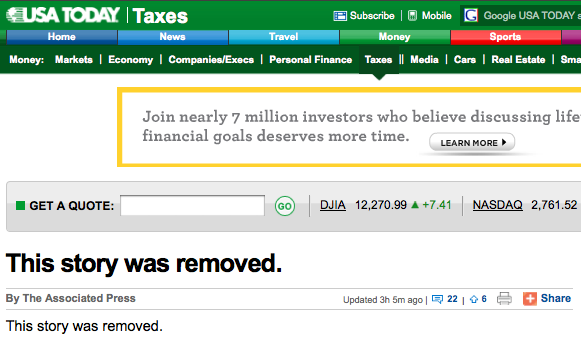
The whole thing is highly embarrassing for Daily Kos. You can bet that any conventional news hierarchy would have done its best to hide the evidence, minimize the damage, and “stand by our story” as much as possible — particularly in light of the likely lawsuits down the road.

Kos instead throws the whole affair onto the table and declares war on his former polling partners. It’s not pretty, but in its own way it’s admirable.

[Cross-posted to my personal blog at Wordyard]

The Wall Street Journal: Cavalier about corrections?

Last week I wrote about my fruitless quest to alert the Wall Street Journal to a mistake it had made in a book review — misspelling the name of the author the piece mainly focused on.

Yesterday I made one final effort to close this loop; I emailed the book review’s author, Philip Delves Broughton. Broughton responded quickly and courteously, agreed that it was a mistake (one he’d been responsible for), and noted that as a freelance contributor all he could do was notify the book review’s editor.

As of today this mistake, now 11 days old, remains uncorrected. In the face of my persistent and no doubt annoying barrage of emails, phone calls, and blog posts, the Journal newsroom has remained entirely mum.

Now, there are a few ways to read this situation. You could say: Who cares? It’s just a misspelling of somebody’s name.

If it’s your name, of course, you may care a great deal. If you’re the author, you might care not just for vanity, but for the sake of the people who might be Googling your writing or looking your book up to purchase it on Amazon.

In this case, the author, Mac McClelland, happens, right now, to be doing some on-the-ground reporting from the Gulf oil spill for Mother Jones. If you were her, you might want readers to connect the book review with the in-the-news byline.

So another possible response is: The Journal’s editors and reporters are very busy people. They’ve got financial meltdowns to cover. Why are you harassing them with this trivia?

That’s just fine — unless the Journal actually cares whether its readers trust its coverage. If a news outlet can’t be bothered to get an author’s name right, can you count on it to get the financial stories right?

I’m sorry, but none of these responses is adequate. Until and unless we get a more plausible response, the only interpretation that makes sense is a very sad one: that the Wall Street Journal, once one of the world’s great trusted news institutions, lacks a functioning correction process. Or it simply doesn’t care about sweating the details any more.

UPDATE: This post is now linked to from Romenesko, and the very first comment there provides a nice illustration of my argument. Mark Jackson writes, “Really? This is a big deal to you? Column inches. Limited space. Priorities. Possibly the world financial system crashing was a bigger issue? Just sayin’.”

It seems to me that the Journal has every right to say, “We no longer have the resources to fix small errors like misspelled names. You should no longer count on us getting that stuff right.”

Something tells me no editor at the paper is likely to say that. Because when most of us signed on as journalists we signed on for the small stuff too. And readers expect that — and expect some kind of response from the newsroom when they point out an error.

[Crossposted at my personal blog at Wordyard.com]

AP’s complicated Seinfeld episode

Recently a MediaBugs user reported that an Associated Press story had misidentified the “Seinfeld” character George Costanza as Jerry’s “neighbor” on the show. Eventually the AP’s west coast entertainment editor, Steve Loeper, responded to an inquiry about the matter, and the AP subsequently decided to publish a correction.

It was a positive outcome, but here’s the rub: Getting to it involved no less than contacting five different people, sending eight emails and making three phone calls — and it took more than three weeks to get a result.

Indeed, one of our early observations with MediaBugs has been that reporting an error to news organizations — even (or is it especially?) large, reputable ones — can be difficult and time-consuming.

When the “Seinfeld” bug appeared on our site on April 28th, I searched online for a specific channel through which to contact the AP regarding errors. I couldn’t find one. (Apparently one does not exist; more on that in a minute.) The AP story had no byline but was datelined Los Angeles, so I looked up the LA bureau and sent an email to the news editor there, Brian Melley. Having been a news editor myself at a busy national media outlet, I knew his inbox was likely to be inundated. I followed up with another email two days later. A couple days after that I tried calling, and emailed again on the heels of that. Then I also tried emailing the LA bureau chief, Anthony Marquez.

Next, I thought to contact an acquaintance who works as a reporter for the AP in Washington, to see if I was even poking in the right place. I learned from her that the news service has a decentralized system for corrections; the AP reporter and/or editor on a specific story apparently is responsible for handling any potential correction. I had been poking in the right place, if to no avail.

Next I tried emailing another person I knew of who used to work in the AP’s LA bureau, to ask if there was anyone else there I might try. He suggested contacting Loeper. After a couple of emails and a voicemail, Loeper responded in timely and good-humored fashion, and we were on our way to a correction. (While the bug ostensibly had been posted by a “Seinfeld” devotee, Loeper subsequently told me via email that the AP “got the definitive word from Rick Ludwin, the NBC executive in charge of the ‘Seinfeld’ series back in the ‘90s, who noted that Kramer and Newman lived in Jerry’s building, but George had his own apartment in another building and also lived with his parents for a time.”)

In the end, AP did right by the error. It wasn’t an earth-shattering one. But rather than getting into whether it’s important for such errors to be corrected (see here and here for why we believe it is), a simple question instead: why does it have to be so hard to get an error fixed?

You can almost hear Jerry working it into one of those nightclub monologues he used to close the show with: “What’s the deal anyway with these newsroom people? You see a simple mistake, so you try to let them know — you email and you call, and you call and you email, and… nothing. Really? What’s the deal with that?” (Cue laugh track.)

How hard is it to report an error to the Wall Street Journal? Hard.

The correction process is a simple thing in most newsrooms, right? If the news outlet gets something wrong, people will tell the editors — they’ll email or call or post a comment on the website. And then the editors will correct the mistake.

End of story? If only.

One of the early field results of the MediaBugs experiment is a simple one. It turns out that, in the case of many news organizations, including some pretty prominent ones, just figuring out how to tell the newsroom that there’s a problem requires persistence and stamina.

Consider this anonymous error report we received at MediaBugs a few days ago. It said that the Wall Street Journal, in a recent book review, had misspelled the name of the author being reviewed. The book is Mac McClelland’s For Us Surrender Is Out of the Question. The Journal spelled her name “McLelland.” (The publisher’s page listing the book, which I’ll take as an authoritative source, spells it with the extra “c.”)

Now, MediaBugs is focused on Bay Area-based news organizations and coverage, and — while we’ll handle reports that focus on the Journal’s Bay Area coverage — we’re not going to deal with most of the paper’s content. So we marked the McClelland report “off topic.”

But I figured that it did seem to be a real mistake, albeit a small one (but not that small, unless you think misspelling the name of the central subject of an article is not a big deal). If I were an editor at the Journal I’d want to know about it and correct it. So as a courtesy I set out to inform the newspaper.

My first stop was the story’s comments, where I thought I’d just post the information and let the Journal editors glean it at their leisure. The page had zero comments, so I figured my note would not be lost in a sea of rants.

I wrote a brief note about the problem, then discovered that I would need to register at the Journal site before they’d accept my comment. So I registered and confirmed my email address, re-entered my comment, and clicked “post.” Nothing happened. I tried again with a different browser, guessing that there might be some browser-specific posting bug. No luck with either Firefox or Safari. No wonder the story has zero comments! So much for that feedback channel. (To try to figure out what the problem was, I took a look at the next day’s Journal books piece. It had five comments — so sometimes, I guess, the comments work. Interestingly, these comments reported errors in that review: it contained impossible, self-contradictory dates. These errors were reported five days ago. The piece has not been corrected.)

For my second approach, I looked for some link on the Journal site for “corrections” or “report an error.” No such link exists on the Journal home page, nor did searching voluminous “Help” and “Customer Service” pages turn up anything. The “Contact us” page offers three general email addresses for feedback, labeled as follows:

Send a comment/inquiry about an article or feature in The Wall Street Journal to: wsjcontact@dowjones.com.

React to something you’ve read on WSJ.com at: newseditors@wsj.com.

Offer a comment/suggestion about features and content on WSJ.com at: feedback@wsj.com.

I challenge anyone who is not a part of the WSJ organization to interpret which of these three lines of inquiry would be an appropriate choice to report an error. Apparently there’s a distinction between responding to the print and Web editions of the Journal, but what about with stories that appear in both places, as is the case for so much Journal content? And what are we supposed to make of the distinction between “reacting to something you’ve read” and “offering a comment/suggestion about features and content”?

I opted for door number one, since I was reporting a mistake in the printed Journal and that seemed to be the choice relating to the newspaper as opposed to Web-only material. But plainly I was grasping at straws. I sent a polite note to the wsjcontact address, and copied it for good measure to the managing and executive editors’ addresses that were also listed on the Contact page. This was two days ago.

For my third effort, I resorted to the good old telephone. The Journal only lists a single phone number on its Contact page, so I called it. It turns out to be an automated inbox for the entire Dow Jones operation. So you walk your way through the voice menu patiently, only to end up at a recording that tells you there’s no one to receive your call but you’re welcome to leave a message.

So that’s what I just did. I will now rest from my labors. We’ll see if any of these efforts elicits a response, or whether this post somehow prods the Journal beast from its slumber.

I went to these lengths because, right now, this is my work. But we shouldn’t have any illusions about normal members of the public. They won’t jump through these hoops. They will conclude — rightly or wrongly but very understandably, either way — that the newsroom doesn’t actually care about hearing about its mistakes.

If we want to understand why people don’t trust the media, this might be a very good place to start.

[Crossposted to my personal blog at Wordyard.]

When reporting an error in the comments is not enough

Our public beta of MediaBugs.org has been open for about three weeks now. We’re still tinkering with our interface, coping with problems at our Internet service provider, and working on plans to increase participation. But we’ve already got some fascinating results from our experiment.

Here’s what I think is the most interesting one so far: The first two errors that we helped get corrected were (1) a listing in the East Bay Express that provided the wrong location for a theater event; and (2) a reference in a TechCrunch story to the wrong police department. In both of these cases, the problem had already been reported to the media outlets in question — in their own comments.

Neither error was earth-shattering, but neither was as trivial as, say, a simple typographical error. Yet the comments reporting the mistakes had sat on these websites for days (in one of the cases, over a week) without either a response or a correction. In each case, it took additional steps to get the newsroom to put fixing the error at the front of its to-do list: First, someone had to file an error report with MedisBugs (OK, in one case it was me!); then, we contacted the news outlet directly and asked for a response.

I bring these particulars up not to shame the news organizations involved, each of which handled itself professionally and responsively, but rather to underscore a point that many of us still don’t realize: Even though most journalists aim to get facts right and to fix things when they don’t, actually getting a news organization to respond and make a correction often takes a lot more effort than it should.

There’s bureaucratic inertia to be overcome. There’s every newsroom’s tendency to focus on tomorrow’s story and not devote a lot of time and thought to yesterday’s. There’s the simple fact that most newsrooms today have fewer and fewer employees. And there’s also, occasionally, the journalist’s hope that if he ignores a complaint long enough, it might just go away.

Now, two error reports is hardly a good sample size, and we’ll need more data before trying to draw any definitive conclusions. For now, what we have is some anecdotal support for what was one of the assumptions behind MediaBugs from the beginning: That the feedback loop between news producers and the public need to be made much more efficient.

Media outlets have opened the door to comments on their websites, but these discussion threads turn out not to be a very good channel for getting the outlet’s attention and motivate it to fix a mistake. If, as we believe, fixing mistakes promptly and prominently is one of the keys to restoring public trust in news media, then MediaBugs can play a useful role by tightening up those feedback loops.

[this post crossposted from PBS MediaShift IdeaLab, which we contribute to]

Why our site is slow

If you’ve been visiting MediaBugs.org this week you may have noticed that the site is intermittently very slow to load. We’re so sorry for this.

It’s not the fault of our software, but rather, a problem with our ISP, MediaTemple. Several thousand of their customers seem to have been affected. And they’re working on it.

With any luck it will all be over soon. In the meantime, our apologies.

UPDATE 5/14/2010: After intermittent ISP troubles throughout the past two weeks we seem to be out of the woods. As of a couple of days ago MediaTemple reported that they’ve dealt with the problem, and we’ve noticed no slowness on the site — but if you do by all means let us know!

How should MediaBugs handle reports about grammar, spelling, and writing?

MediaBugs was originally proposed as an experiment in correcting errors in news coverage. But what, exactly, is an error?

We’ve concentrated our efforts on the notion of “correctable errors,” which means, primarily, errors of fact, or sometimes of context and emphasis.

A handful of our early bug reports have been more in the area of bad grammar, questionable sentence structure, cliched phrasing and so forth — the realm, traditionally, of copy-editing, an art and vocation that is, sadly but probably irreversibly, in decline.

Personally I would rather see MediaBugs reports concentrated more in the realm of errors than of copyediting. (For a different sort of experiment in collaborative online copyediting,but one that’s very much in the MediaBugs spirit, check out Goosegrade/Editz.) But we’re committed to being guided to some extent by our users as long as what they’re doing is roughly aligned with our project goals.

What do you think — should MediaBugs take on all sorts of small copyedits? Should it delete them and focus on the factual/substantive stuff? Or maybe accept the copyedits but somehow segregate them on the site?

Welcome to the MediaBugs public beta!

Today we’re removing the drapes and unveiling MediaBugs to the world. We’re still in beta mode, which means that we’ll probably be fixing our own bugs and spiffing up the place for some time. But everything’s in place for you to use MediaBugs to help fix the news, beginning now.

You can register, learn more about our bug criteria, and check out recent bugs. And by all means send us comments and questions and tell us about any problems you encounter!

Gentle people: on your mark, get set, report bugs!

Welcome to the “closed beta” of MediaBugs.

Um, what’s a closed beta, you ask? Truth is, it’s not really all that closed. We’re giving accounts to pretty much anyone who asks. We haven’t locked our test site away behind a lock and key. We’re just not heavily promoting it or passing around its URL while we get things in order.

What we are doing is inviting a relatively small group of people — friends, well-wishers, experts, people who’ve told us they’re interested in the project — to help us in two ways before we fling open the doors more widely:

(1) Reporting some errors in news coverage, some initial media bugs that we can seed the site with — so that those people who come by once we’re more fully public can get a quick sense of what we’re all about and how things work here.

(2) Reporting our bugs back to us so that we can provide the wider public with as smooth an experience as possible.

We’re figuring on this phase lasting two to four weeks. If you want to help out, just get in touch and we’ll send you the seekrit entry info.